2. How CST Relates to All Subjects
a. Religious Education (RE)
This is the most direct application:
- CST is studied explicitly.
- Students explore social justice, moral theology, and the life of Christ, who calls us to serve “the least of these” (Matthew 25:40).
- Students encounter the writings of Popes (e.g., Rerum Novarum, Laudato Si’, Fratelli Tutti), Saints, and Church Councils.
b. English / Literature
- Students analyse themes of justice, human dignity, suffering, and redemption.
- Literature becomes a lens through which to explore moral questions.
- Discussions are infused with the CST vision of human flourishing and community.
E.g., reading Steinbeck’s Of Mice and Men can lead to questions about the dignity of the marginalized, echoing the Church’s preferential option for the poor.
c. History
- CST helps students interpret historical events through a moral and theological lens.
- Issues such as colonialism, war, civil rights, and economic inequality are discussed in light of human dignity and the common good.
- Students evaluate historical figures not only for their achievements but also for their moral impact.
d. Science
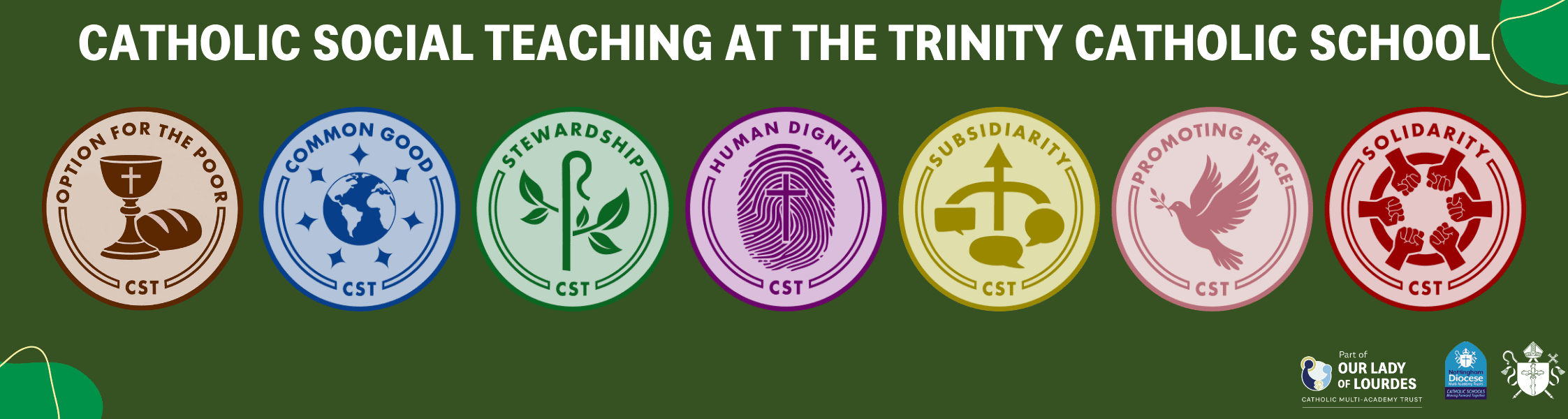
- CST emphasizes stewardship of creation: science is a gift for understanding and caring for God’s creation (Genesis 2:15).
- Ethical concerns (climate change, genetic engineering, nuclear energy) are approached from a Catholic moral framework (Laudato Si’, §159).
- Students are taught to pursue scientific truth with humility and responsibility.
e. Mathematics
- Mathematics forms the rational foundation for economic and environmental justice.
- In subjects like statistics, students learn to interpret data related to global poverty, access to clean water, or social inequality.
- Math is seen as part of God’s ordered creation, reflecting divine harmony and reason.
f. Geography
- CST enriches topics on global inequality, migration, urbanisation, and environmental issues.
- Topics like climate justice and resource distribution are examined through solidarity and stewardship (Caritas in Veritate, §48).
g. Citizenship / PSHE (Personal, Social, Health and Economic Education)
- Strong alignment with CST, particularly around human rights, justice, democracy, and social responsibility.
- Emphasis on participation and subsidiarity—forming students who engage in society to transform it with Gospel values.
- Deep respect for conscience formation (cf. Gaudium et Spes, §16).
h. Art / Music
- Creativity reflects the Imago Dei—the image of God who creates.
- Students express human dignity, suffering, and hope through art.
- Artistic disciplines offer space for contemplation, solidarity, and communion with the marginalised and oppressed.
3. The School Itself Must Embody CST
More than curriculum content, CST must form the ethos of the school:
- Every student is treated with dignity.
- Policies reflect justice, inclusion, and mercy.
- Service to others is encouraged as part of the educational mission.
- Staff are treated fairly and supported in their vocations.
The Catholic Bishops’ Conference of England and Wales emphasises that Catholic schools are not just places of academic achievement, but are also communities of faith, hope, and love, formed by Christ and directed toward the transformation of the world.
- Conclusion: Education as Evangelisation
St. Paul said, “Be not conformed to this world: but be reformed in the newness of your mind” (Romans 12:2, DR). Catholic education must form not only skilled minds, but converted hearts. Every subject, every lesson, every encounter must point toward the greater reality of God’s Kingdom, where truth, beauty, justice, and love are one.
In a Catholic secondary school, CST is not an “add-on”—it is the soul.