Catholic Social Teaching at Trinity Catholic School

At Trinity Catholic School, our mission

“To the Glory of God we build our school on faith, love and respect”,

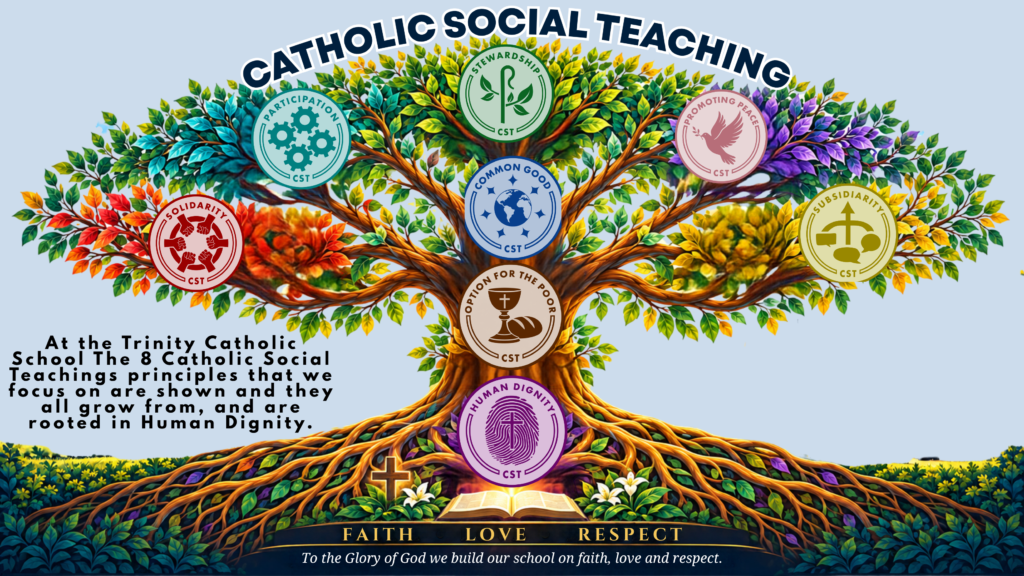
is lived out through Catholic Social Teaching (CST), which forms a central pillar of our Catholic Character Education.

CST ensures that our faith is not confined to prayer or liturgy alone. It shapes how we think, how we learn, how we relate to one another, and how we act in the world. It calls us to form young people who are morally responsible, socially aware, and committed to building a society rooted in justice and love.

Catholic Social Teaching flows from Scripture, the life of Christ, and the Church’s tradition, from Rerum Novarum (Pope Leo XIII) through to the social teaching of recent popes. At Trinity, it is intentionally embedded across subjects and in the daily life of the school.
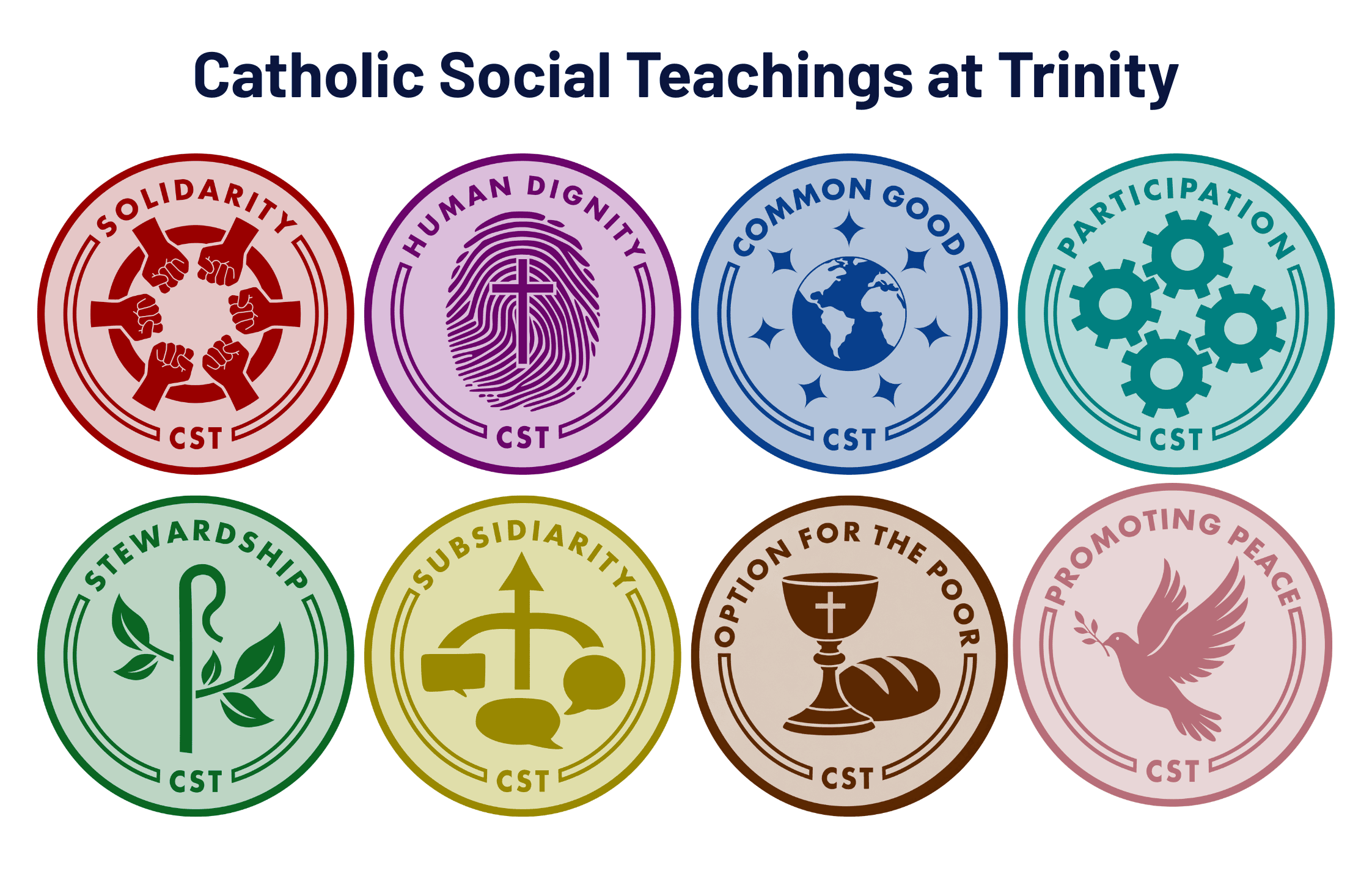

 

  1. Human Dignity

“Before I formed you in the womb, I knew you.” Jeremiah 1:5

Every person is created in the image and likeness of God (Genesis 1:27). This principle is foundational.

In school life:

  • Strong safeguarding and pastoral systems
  • Inclusive SEND provision
  • Respectful relationships policy rooted in restoration and reconciliation

Across the curriculum:

  • RE: The theology of the human person; Imago Dei
  • Science: Ethical discussions around genetics, life issues, and bioethics
  • English: Exploring identity, prejudice, and moral choice in literature
  • PSHE: Human rights, dignity, and respect


  1. The Common Good

All the believers… shared their belongings with one another.”  Acts 2:44–45

The common good means creating conditions where everyone can flourish.

In school life:

  • Clear expectations that promote community over individualism
  • Leadership opportunities that emphasise service

Across the curriculum:

  • History: The development of democratic society and social reform
  • PSHE and Politics: Rights and responsibilities in modern Britain
  • Business: Ethical enterprise and corporate responsibility
  • PE: Teamwork and collective success


  1. Option for the Poor and Vulnerable

Whatever you did for one of the least of these… you did for me.”  Matthew 25:40

Christ shows a preferential love for the poor. This shapes our priorities.

In school life:

  • Targeted academic and pastoral support
  • Charitable outreach and partnerships
  • Social action projects

Across the curriculum:

  • Geography: Global inequality and development
  • RE: The Church’s mission and Caritas
  • Mathematics: Interpreting statistics on poverty and social trends
  • Art and Drama: Using creative expression to raise awareness of injustice


  1. Solidarity

We are one body in Christ.”  Romans 12:5

We belong to one human family.

In school life:

  • Global partnerships
  • Chaplaincy-led campaigns
  • Prayer for international crises

Across the curriculum:

  • Modern Foreign Languages: Understanding other cultures
  • History: Migration, conflict, and reconciliation
  • Music: Cultural diversity and shared human expression
  • Sociology: Social cohesion and community identity


  1. Dignity of Work and Participation

Whatever you do, work at it with all your heart.”  Colossians 3:23

Work is participation in God’s creation and a path to human dignity.

In school life:

  • Careers education rooted in vocation
  • Celebration of effort and contribution
  • Student leadership structures

Across the curriculum:

  • Business Studies: Workers’ rights (linked to Rerum Novarum)
  • Design and Technology (DT): Creativity and craftsmanship
  • Careers Programme: Work as vocation, not merely employment
  • Mathematics: Financial literacy and responsible stewardship


  1. Subsidiarity

“Speak up for those who cannot speak for themselves.” Proverbs 31:8–9

Decisions should be made at the most appropriate level, enabling participation and responsibility.

In school life:

  • Student voice systems
  • Prefects and chaplaincy leadership
  • Collaborative decision-making

Across the curriculum:

  • PSHE: Local and national governance
  • History: The development of parliamentary democracy
  • RE: The structure of the Church and shared mission


  1. Stewardship of Creation

“The Lord God placed the man in the garden to cultivate and guard it.”  Genesis 2:15

Creation is a gift entrusted to our care.

In school life:

  • Eco initiatives
  • Sustainable practices
  • Environmental awareness campaigns

Across the curriculum:

  • Science: Climate science and sustainability
  • Geography: Environmental change and responsibility
  • DT: Sustainable design
  • Art: Creation as inspiration and responsibility


  1. Promoting Peace

“Blessed are the peacemakers.” Matthew 5:9

Christ calls us to be builders of peace rooted in justice.

In school life:

  • Restorative behaviour systems
  • Anti-bullying initiatives
  • Prayer and reflection during global conflict

Across the curriculum:

  • History: Causes and consequences of war
  • RE: Just War theory and forgiveness
  • English: Literature exploring reconciliation
  • Drama: Conflict resolution through performance


CST as Formation, Not Decoration

At Trinity, Catholic Social Teaching is not an additional theme week or a display board initiative. It is a framework for moral formation.

It ensures that:

  • Academic excellence is ordered towards service
  • Leadership is rooted in humility
  • Success is measured by contribution as well as attainment
  • Character is shaped by virtue and responsibility

In this way, Trinity forms young people who understand that faith and reason work together, and that their education is preparation not only for examinations, but for participation in God’s mission in the world.